A conceptual framework: Navigating together as explorers
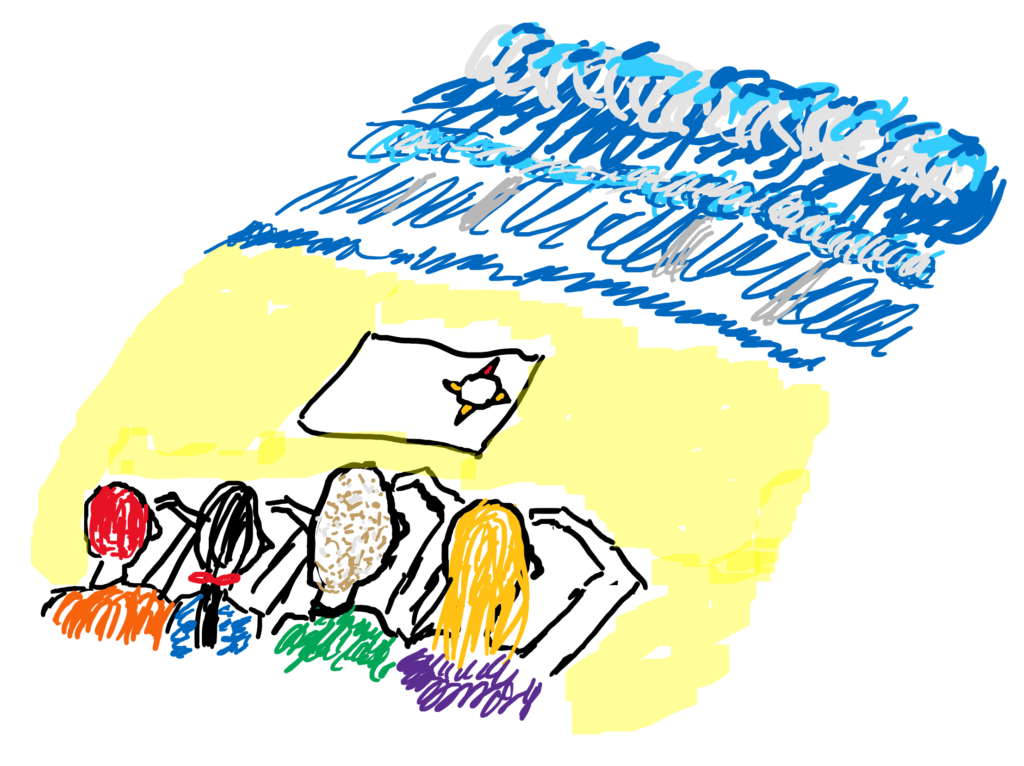
My metaphor is a group of explorers navigating together to distant shores.
Explaining the image and metaphor
People searching
The people searching are along each other rather than having a ‘master navigator’ leading the group. This is a reference to tauira and kaiako walking alongside each other. The are looking out to the moana, this is where they hope to explore, along side each other, and having thought about where they might like to head. This is a reference to co-constructing the classroom and breaking bread with students, sharing their experiences of success and failure.
The Map
The map is only labelled with a direction arrow. This direction arrow is the New Zealand Curriculum and the school’s expectations. Aside from these markings the actual map is up to the navigators to construct. This is a reference to tauira, whānau and kaiako co-constructing the classroom.
The Ocean
The Ocean has some waves in this photo. This represents real life conditions that we all face and our challenges in life. Navigators are only truly navigators if they actually take up the wero and head out to explore. This is a reference to the tauira and teacher’s challenges they will face if they are to navigate to distant unknow places. However, like every journey, there is risk and reward.
Learning through exploration
When I think about my own life, and what I’ve done up until now, I think about all the exploration I have done as a secondary student then as an adult. It’s not just the places I have been, but the people I have met and the things I have learnt along the way. This continual exploration drives me till today, where I have found myself at Ako Mātātupu, as a beginning teacher. It is a relentless restlessness that drives me to seek out new challenges and intrigues. It began when I was a similar age to some of the tauira that I will be teaching. It was when I was around 16 when I started listening to different music, entering into discussions about whether or not it was ethically sound to eat meat as well as debating in English class to argue why John Proctor from The Crucible was right to not confess, and hang, rather than implicate others in crimes they did not commit. It is this love of the exploration of ideas that I want to give to my students.
Firstly we can’t explore if we don’t first know where we come from, and what brings us to where we are in this present moment. I want to incorporate the culture of my tauira and my culture in the classroom before we go exploring. One thing that is important to me is to use te reo Māori and tikanga Māori in the classroom. I am likely to have Māori tauira in the classroom, but beyond that it is important for everyone in the classroom to know that the learning we are doing is within a culural context, and that should be a bicultural context. At the graduating teacher level we should be using local indigenous knowledge in the classroom . I will add indigenous knowledge when I am able to by asking whānau for their assistance and stories, and by doing research on the local area. I am also guaranteed that I will have students from Pacific Island backgrounds (whether born in Aotearoa or overseas) in my classroom. Tapasā is the cultural compentency framework for working with Pacific tauira . Turu 1, states that identities languages and cultures are important, and that where possible kaiako should utilise pacific knowledge in the classroom. I am a novice when it comes to pacific cultures, but I will try to understand where my tauira are coming from and get their input to add in to our classroom. I will ask tauia and whānau to contribute this knowledge to the classroom, as well as do more investigation myself. This shows a commitment to learners by respecting the diversity of the heritage, language, identity and culture of tauira; it also shows a commitment to society, through demostrating committment to Tiriti o Waitangi, and a bicultural Aotearoa .
We also can’t explore unless we build a good relationship. When navigating together we need to communicate where we are going, and how we think we are best to get there. This communication requires a good relationship. When the moana is choppy, there will be times that tough conversations need to be had. Having a good foundational relationship prior to having these conversations is key to doing it in a mana-enhancing way. Bishop argues that relationships are fundamental to learning. He uses the metaphor of the extended family or whānau to talk about the relationships. In part, this is about being my authentic self to the classroom, being fair and just, and treating people as adults . Fostering and nuturing these relationships also corresponds to Ako Mātātupu’s value of Teu Le Vā, or of maintaining the relationship space. These are all things I value as a person, and utilise in my teaching.
When we explore together it is less about me transmitting knowledge, and more of a interaction between tauira and kaiako. The where do we go next? questions can be prompted by myself, but ultimately it is up to the tauira and whānau to decide. Ako, or a shared learning between kaiako and tauira is a co-construction of learning . This will mean that tauira and whānau and I will have valuable ideas about how tauria best learn, and what they want to get out of the classroom environment. It is my job to help facilitate these discussions early on in the year. However, there is may be some tension between co-constructing our classroom and having to follow the New Zealand Curriculum and school guidelines which will dictate some things must occur . These boundaries, however, will be good for our exploration. Having some indication of where we need to go will help us not get lost while exploring. Any islands that we do stumble across on our journey, such as extra development opportunities or study that goes beyond the curriculum are great as we strive to meet the values of excellence and innovation, inquiry and curiosity which embedded in the New Zealand Curriculum. Ako also means that we have It is also understood that Ako means both Tauria and Kaiako are teachers and learners, and that learning happen through dialogic interaction . These aspects of co-construction of the learning journey show a commitment to the teaching profession, by using high-quality and effective teaching strategies .
As we are exploring together we need some provisions to help us on our journey. These basic provisions can be thought of as a basic navigation skills. For example, In terms of mathematics this includes knowing how to add, subtract, multiple and divide. I do not expect all tauira to enter with these skills however, and it will be a work in progress for some. It’s also useful to keep practicing these skills at all year levels, because they become important at higher levels of mathematics when using algebraic symbols. Like learning to read a map, or learning to navigate by the stars, you need at least some basic knowledge before you can head out to sea. I will strive to ensure my tauira can read the map (add and subtract) and begin to read the stars (multiply and divide). Even though this may be wrote learning, and not necessarily co-constructed, it is, in my view, necessary to begin to think about where you’d like to navigate to next, and is a very necessary first step for navigators. This relates to the Ako Mātātupu’s practicing excellence value, in that I have high expectations for tauira to be able to know the basics in order to be able to participate fully in the classroom.
The destination of each tauira is unknown, but as explorers we need to think about where we might be heading, and learn to read the stars. As a facilitator of interactions within the classroom, I aim to give tauira a wide variety of different potential places to navigate to. I am fairly open minded, and I want to allow tauira a safe space to explore ideas with each other and myself in a mana-enhancing way. I will make sure my classroom is a safe space for all students to be who they are at heart. One of the principles of the New Zealand Curriculum is inclusion, that is, “what we teach is non-sexist, non-racist and non-discriminatory”. I will uphold the mana of my diverse learners by creating a safe space for all tauira to share.
I will often refer to myself as jack of all trades and master of none. This is how I would like myself viewed. In a similar vein, I am not the master navigator of our classroom nor the master navigator of the lives of my tauira. I have a limited time with my tauira, and I appreciate them placing trust in me to help them explore mathematics. Moreover, exploration is more than just subject knowledge, it is about what things tauira hold to be true and right, developing morals and becoming an active citizen. It is also about discovering what they want to do when they leave school and what they stand for. I will be privileged if I can assist them on this bigger journey that’s on their horizon. I’m sure the tauira will also help me navigate to distant shores, yet unseen.