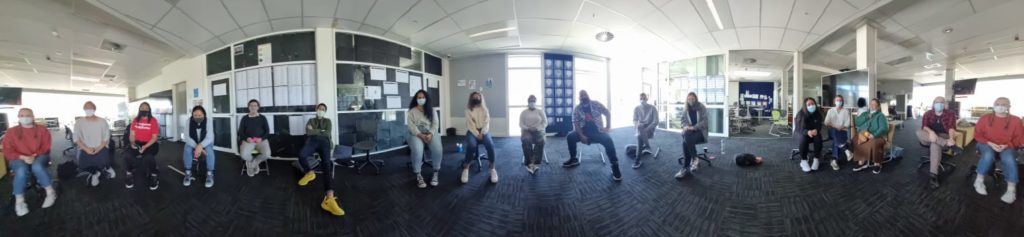
The following prompts were given to us at Wānanga 2 in the initial whakawhanaungatanga session. We also used these prompts with Manaia when we initially came together.
What is my Strength
My Strength comes from the environment I’m in. I have wonderful colleagues at Mount Roskill Grammar School. I try to spend quite a bit of time in the Mathematics work room, which is the hub for our department. If I ever need advice about the school or processes, specific pedagogical practices or help with lesson ideas I can rely on my MRGS whānau.
The fact that my department are amazing was reinforced throughout Wānanga 2. First I heard the stories of other people on the course, many of whom haven’t yet been supervised, or only once or twice, or are struggling to integrate into the school. It also occurred to me that I am very lucky to be in the school where I have been a teacher aide for two years as I have good relationships with many people across the school including within my department. This naturally helps me feel at home in my school.
Many thanks to my MRGS whānau for making me feel so welcome! ❤️
What is my Challenge and Hope
My challenge and hope is that I’m living up to Ako Mātātupu’s vision. Most important for the beginning Ako Mātātupu teacher is building relationships with students their whānau, and the community. While I feel like I’ve made good progress with my students in terms of building relationships I don’t feel like I had the same impact with whānau and the wider Mount Roskill Community.
I had great aspirations of engaging whānau and community in lessons. What I have found being in the classroom is that my time is taken up with the myriad of other activities (see below). However, I do realise the importance of these connections, as highlighted by the case studies in Tapasā and the Whanaungatanga strand of Tātaiako . While not impossible, it is also not a norm in our school to have whānau actually in the classroom.
[A Certified Teacher] has respectful working relationships with Māori learners and their whānau, hapū, and iwi that enhance Māori learner achievement.
This was also important in terms of ako in the classroom. Firstly, I have a group of Pasifika boys in my Year 9 class who I am finding it difficult to get engaged with the work we are doing in the classroom. This is placing a strain on the relationships within the classroom, but it is also meaning they are falling behind others in the class. While, I know the theory of creating engaging and relatable content to engage students, I wondering if whānau and community support and giving space for others to teach in the class may be a way of engaging these students.
Therefore, more engaging lessons for my Y9 class and connecting with whānau have to be my next steps. I have to ensure that when I reach out to whānau I’m allowing them to have access to me and perhaps to figure out how I could ask them to contribute in the actual classroom. One of the areas where I actually suggested, during summer intensive, was in the shape unit. Perhaps statistics is another area where I could engage whānau. One logisticaly issue is that I cannot be certain whānau have read and understood the email that we send out to our junior students at the beginning of the year. Therefore, I think it is important to call whānau. I need to pluck up my courage to do this!
What is one thing I’ve learnt (so far…)
One thing I’ve learnt so far is to take things one step at a time. As a beginning teacher there are so many things to think about in terms of pedagogy, classroom management, extra curricular and behavioural issues to name a few. I also have a Hui Ako class (form class), which, while not requiring a big pedagogical or planning input, does require addressing attendance concerns, carrying out formal mentoring conversations and assisting tauira through their journey at MRGS.
“If you need to send a student to the nurse, you’ll need to ring ahead so they can get PPE on”, was the message we were given on day one of school. “How am I going to build relationships, manage the classroom, check the role, deal with lateness and call a nurse?” I wondered.
Therefore, in light of these competing demands, it is easy to become overwhelmed. The solution, in my mind, is to tackle on thing at a time. At the beginning of term one, I was overwhelmed with the amount of different things I needed to do in the classroom. I often talk about the anecdote in the quote above to show the number of things a beginning kaiako might need to deal with in the classroom. One answer, is to deal with things one at a time. There are at least two reasons for this.
The first reason to take things one a time is that it is easy to become overwhelmed. Rafsanjani and Rahmawati argue that teachers experience of stress can impact their enthusiasm of their working environment and increases emotional exhaustion. I think teachers who have low enthusiasm for teaching and are emotionally exhausted are not going to stay in the teaching profession very long. One thing that I have found stressful is the many competing priorities inside and outside of the classroom. Listening to one of my Ako Mātātupu peers during the talanoa, also reinforced this idea as she seemed overwhelmed with everything she had to do in the classroom.
The second reason is that you are unsure which parts of your practice are able to be improved, and what the impact is on your classroom. While I have many things to establish as a beginning teacher, one thing I’ve noticed from my peers in my department is that they tend to only change one element of their teaching practice. They also tend to do this slowly, and make a trial last many months before assessing whether something is working or not. For example, Robert* has trialled a no hands up strategy and been persisting with this for months now. For him, it is still too early to tell whether the intervention has had an impact on learning.
More experienced kaiako also make adjustments to a strategy as they use it in the classroom. For example, while I quickly discarded my traffic lights strategy, my colleagues have kept it, but make subtle changes to it, for example giving cups to a group, and setting the boundaries with the cups (i.e. no playing with the cups). On the other hand, as a beginning kaiako, I feel like I’ve needed to address a multitude of issues in my classroom, and made a ton of changes in a short space of time. I’ve spoken to my colleagues about the fast, informal enquiry cycles that beginning teachers usually do, and I definitely feel like I have been doing this in my classroom.
Manaia o Tū Takitini me te Ahitū – Our first time together kanohi ki te kanohi!
Wiliam, D. (2011). Embedded Formative Assessment. Solution Tree Press.
Rafsanjani, M. A., & Rahmawati, E. D. (2019). Stress Exposure and Psychological Well-being: Study on Beginning Teacher. Journal of Accounting and Business Education, 3(2), 162. https://doi.org/10.26675/jabe.v3i2.5757
Kia ora, ko Daniel ahau! This is my space for sharing my Ako Portfolio. If you want to find more about about me, please visit my main website at danielbeetham.com