Working for school wide outcomes then reaping the rewards
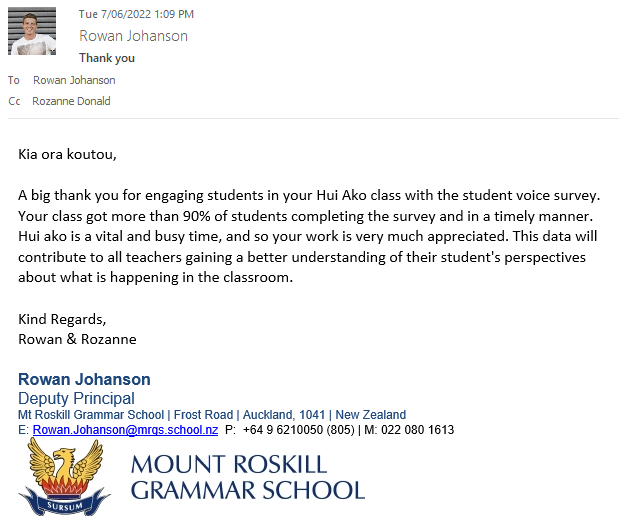
It took quite a lot of effort to get my Hui Ako class to get their student voice survey completed
Part of working in a school is working hard to help achieve the outcomes that the school desires. This may seem like a lot of work at the time, but often the results are worth it. In the case of the student engagement survey, as well as helping my colleagues with getting feedback from students in their class, it also gave me feedback from my tauira.
The feedback from my dashboard shows me that some areas I am getting right and others I can improve on. A success is that I am creating a sense of belonging in the classroom. I believe this is due to creating a relaxed but productive environment to work in. One area I may need to focus on and improve is feedback. Feedback is critical for students to understand where they are going. Hattie and Timperley’s seminal work on feedback, strongly suggests that feedback is important, especially task based feedback. Bishop and Berryman suggest that “students spoke about their desire…to be let in on the secret; that is…learning in such a way that they can monitor their own progress”. Therefore, feedback in the classroom is important.
Not only is my feedback important to me, from the cohort and course comparison graphs, I can see that mathematics classes do not rate highly on feedback overall. There are a few interesting points to note, however. We do have teachers that rate highly for feedback, but they also rate highly overall (the Singh is King effect1), so it might be that students rate effective teachers highly across all scores regardless of how they give feedback. Another curiosity is that mathematics is usually seen as a subject that is easy to give feedback in. That is, questions have a definite answer, and text books often have answers in the back of the book; student should get more immediate feedback than in other classes, for example English and Social Studies, where work is often writing based. Therefore, it may be a disconnect between what teachers assume is feedback and what students understand feedback to be, but it may also be that teachers of other subjects work harder to give feedback.
Therefore, next steps may include highlighting these issues to my peers in our department PLD meetings. I can also ask to confirm these findings, as the DP who is in charge of the student voice survey is also in the mathematics department. We will also get another student voice survey later in the year, so it might be worth raising these issues if I see the same trend. For my self, I may need to talk to others to check in with how they are giving feedback, and try to make sure my tauira are receiving the right kinds of feedback so they can progress towards their goals.
Inviting peers to observe me
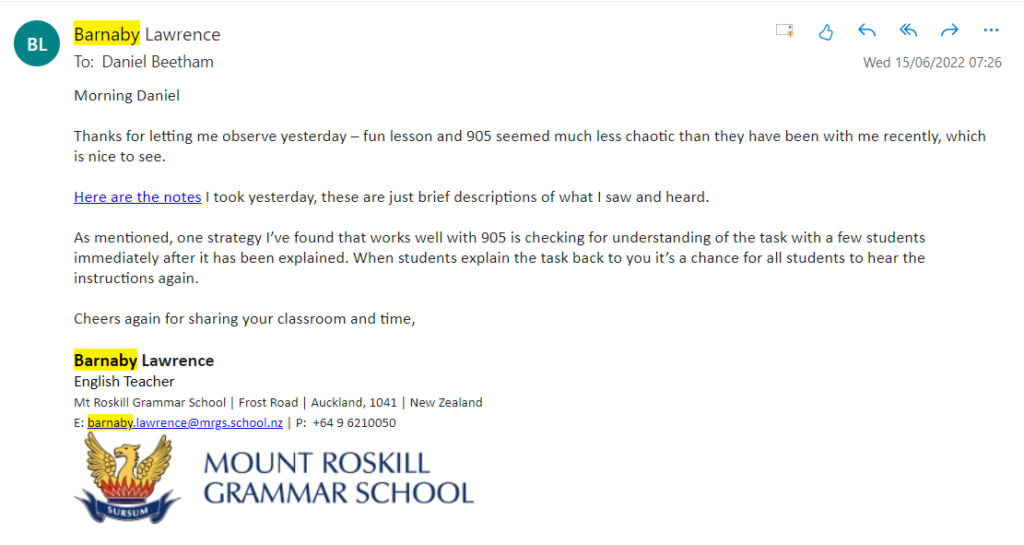
It was great working with Barnaby – who is both 905’s Kaiako (Hui Ako Teacher) and English Teacher
As well as the observations I’ve had with my mentors, specialist classroom teachers and head of Junior Mathematics, I’ve also had the opportunity to work directly with new teachers. This has been really rewarding because I have been able to contribute to Barnaby’s pedagogical practice, and he has been able to contribute to mine. His advice to check for understanding by asking the students what they should be doing is excellent, because I often get many students asking “What are we doing, Sir?”
I believe that I can learn something from anyone who is observing me in the classroom. I’ve enjoyed working with different staff members who have observed me, and I think it’s ideal to have the attitude that I can welcome anyone into the classroom at any point. Different people also come with different perspectives. For example, I had the head of the junior program observe me in my Y10 class, who helped students understand the upcoming summative assessment. I also had my mentor, Kailash, and Kay Hawk in my classroom, which was a double observation, with Kailash observing and mentoring me, and Kay observing and mentoring Kailash. I’ve also taken a video of myself for my colleague to give me feedback on my teaching.
I asked Rees to observe my ‘direct instruction’ from this Y12 Calculus Lesson. The focus of the lesson was to get students to calculate the gradient of a function at a particular value of $ x $. Previous lessons included revision on gradient, sketching gradient functions and differentiation of polynomial functions. My colleague, Rees, was due to come into my class to directly observe the lesson, instead, because he was away from work I recorded myself teaching the lesson. This was perhaps more useful than just having him come and observe me, because I was able to see myself teaching and we could watch back together to review the video.
Rees’ [sumarised] feedback to me
I already had an impression of the lesson before I watched the video; that it wasn’t the best lesson. I though this because the demarcation between Hei Mahi and the lesson wasn’t clear enough, and although I explained the new concept I did not show the working clearly enough. Rees’ feedback touched on this too. He suggested that I focus more directly on the question and how to answer it, and hook students in by saying ‘this is a question from the exam in 2018’. Rees argues that students have a lot of different competing demands and they are not as excited by the theoretical underpinnings of the subject, at least at the beginning of learning a new skill. He suggests there is plenty of time to go back and teach this at a later time.
For me the biggest learnings were about how I should demonstrate new skills to my Y12 class, and how much detail they would need about the ‘why?’. Although I do agree with Rees in part, that being clear on how to do a specific skill with each step is important, I also think it’s important to build some intuition. For example, when I was teaching students to find stationary points, instead of getting them to memorise that $ f'(x) = 0 $, I would rather draw a quick sketch of a cubic function and ask students what they know about the gradient at the stationary/turning points. However, there is a happy middle between these two where we break down why we are doing particular operations at each step. Therefore, for me, I will continue to build students ‘why’ but also to be clearer about each step (labelling) and have a example on the board for students to use in subsequent questions. This focus on direct instruction is important because I want to know that students know what are doing and how to do it .
[1] The Singh is King effect is based on one teacher in our school who is excellent across all domains, and is admired across the school. I was lucky enough to work in his classroom in 2020 and 2021, while I was a teacher aide.
Kia ora, ko Daniel ahau! This is my space for sharing my Ako Portfolio. If you want to find more about about me, please visit my main website at danielbeetham.com